Acne Vulgaris Resistant to Conventional Treatment: Current Evidence on Systemic Therapies and Management Strategies
DOI:
https://doi.org/10.5281/zenodo.23303408Keywords:
Acne vulgaris, Treatment resistance, Isotretinoin, Systemic therapy, Antimicrobial resistanceAbstract
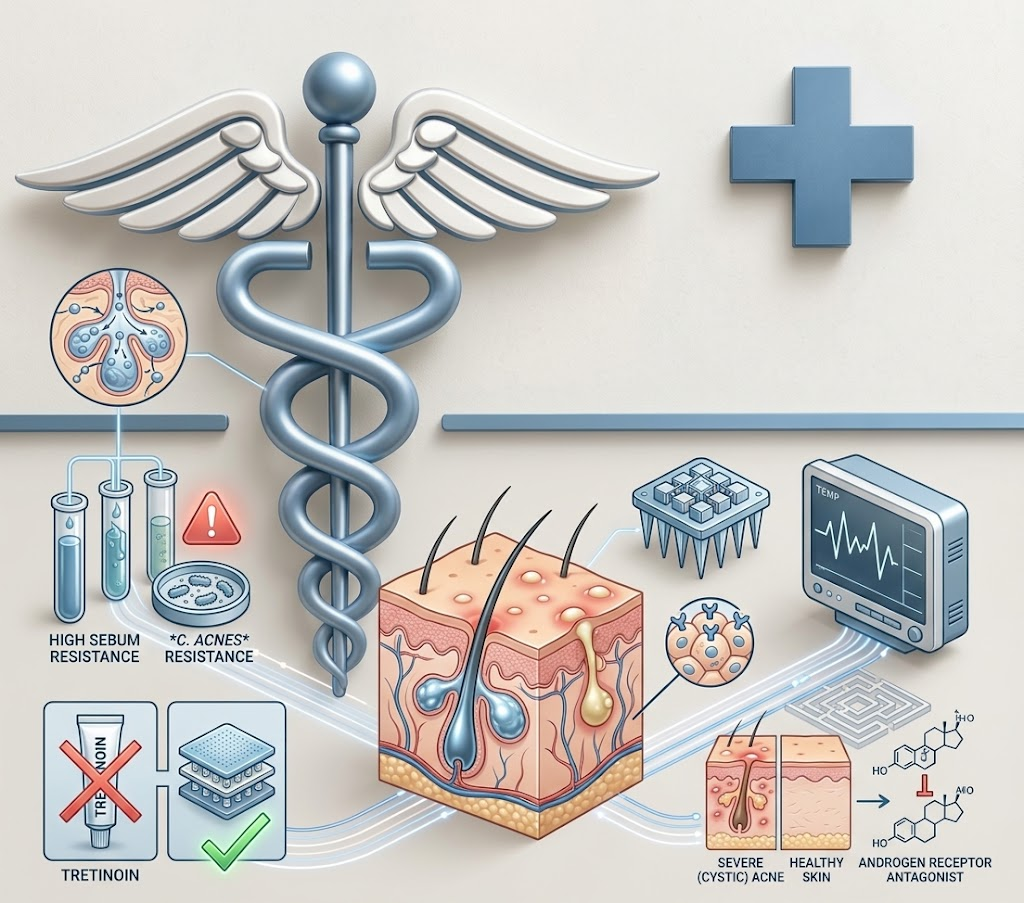
Acne vulgaris is a chronic inflammatory disease of the pilosebaceous unit that may persist despite conventional treatment, increasing the risk of scarring and psychosocial consequences. This study aimed to review the scientific evidence on the pathophysiology of treatment-resistant acne, the main systemic therapies, and current clinical management strategies. A narrative literature review was conducted, considering clinical studies, scientific reviews, and therapeutic guidelines related to the disease. The analysis addressed the mechanisms involved in lesion development, factors associated with inadequate treatment response, and available pharmacological options. Oral isotretinoin plays a central role in the treatment of severe, scarring, or refractory acne, whereas systemic antibiotics require judicious use because of the risk of antimicrobial resistance. Hormonal therapies represent alternatives for selected patients, according to their clinical characteristics and contraindications. It is concluded that the management of treatment-resistant acne should be individualized, incorporating assessment of treatment adherence, pharmacological safety monitoring, and strategies aimed at preventing scarring, maintaining therapeutic outcomes, and improving quality of life.
References
BEIG, M. et al. Prevalence of antibiotic-resistant Cutibacterium acnes (formerly Propionibacterium acnes) isolates, a systematic review and meta-analysis. Journal of Global Antimicrobial Resistance, v. 39, p. 82-91, 2024. DOI: https://doi.org/10.1016/j.jgar.2024.07.005.
BHATE, K.; WILLIAMS, H. C. Epidemiology of acne vulgaris. British Journal of Dermatology, v. 168, n. 3, p. 474-485, 2013. DOI: https://doi.org/10.1111/bjd.12149.
BOYANOVA, L. Cutibacterium acnes (formerly Propionibacterium acnes): friend or foe? Future Microbiology, v. 18, p. 235-244, 2023. DOI: https://doi.org/10.2217/fmb-2022-0191.
DESSINIOTI, C.; KATSAMBAS, A. The microbiome and acne: perspectives for treatment. Dermatology and Therapy, 2024. DOI: https://doi.org/10.1007/s13555-023-01079-8.
FALLAH, H.; RADEMAKER, M. Isotretinoin for acne vulgaris: an update on adverse effects and laboratory monitoring. Journal of Dermatological Treatment, v. 33, n. 5, p. 2414-2424, 2022. DOI: https://doi.org/10.1080/09546634.2021.1967269.
KNUTSEN-LARSON, S. et al. Acne vulgaris: pathogenesis, treatment, and needs assessment. Dermatologic Clinics, v. 30, n. 1, p. 99-106, 2012. DOI: https://doi.org/10.1016/j.det.2011.09.001.
KUROKAWA, I.; NAKASE, K. Recent advances in understanding and managing acne. F1000Research, v. 9, art. 792, 2020. DOI: https://doi.org/10.12688/f1000research.25588.1.
NATIONAL INSTITUTE FOR HEALTH AND CARE EXCELLENCE (NICE). Acne vulgaris: management. Guideline NG198. Londres: NICE, 2021. Atualizado em 30 abr. 2026. Disponível em: https://www.nice.org.uk/guidance/ng198. Acesso em: 11 out. 2026.
REYNOLDS, R. V. et al. Guidelines of care for the management of acne vulgaris. Journal of the American Academy of Dermatology, v. 90, n. 5, p. 1006.e1-1006.e30, 2024. DOI: https://doi.org/10.1016/j.jaad.2023.12.017.
SANTER, M. et al. Effectiveness of spironolactone for women with acne vulgaris (SAFA) in England and Wales: pragmatic, multicentre, phase 3, double blind, randomised controlled trial. BMJ, v. 381, e074349, 2023. DOI: https://doi.org/10.1136/bmj-2022-074349.
SARDANA, K. et al. Antibiotic resistance to Propionibacterium acnes: worldwide scenario, diagnosis and management. Expert Review of Anti-infective Therapy, v. 13, n. 7, p. 883-896, 2015. DOI: https://doi.org/10.1586/14787210.2015.1040765.
TAN, J. et al. Evaluation of psychological well-being and social impact of atrophic acne scarring: a multinational, mixed-methods study. JMIR Dermatology, v. 5, n. 1, p. 43-50, 2022. DOI: https://doi.org/10.1016/j.jdin.2021.11.006.
TUCHAYI, S. M. et al. Acne vulgaris. Nature Reviews Disease Primers, v. 1, art. 15029, 2015. DOI: https://doi.org/10.1038/nrdp.2015.29.
VASAM, M.; KORUTLA, S.; BOHARA, R. A. Acne vulgaris: a review of the pathophysiology, treatment, and recent nanotechnology based advances. Biochemistry and Biophysics Reports, v. 36, art. 101578, 2023. DOI: https://doi.org/10.1016/j.bbrep.2023.101578.
WILLIAMS, H. C.; DELLAVALLE, R. P.; GARNER, S. Acne vulgaris. The Lancet, v. 379, n. 9813, p. 361-372, 2012. DOI: https://doi.org/10.1016/S0140-6736(11)60321-8.
ZAENGLEIN, A. L. et al. Guidelines of care for the management of acne vulgaris. Journal of the American Academy of Dermatology, v. 74, n. 5, p. 945-973.e33, 2016. DOI: https://doi.org/10.1016/j.jaad.2015.12.037.
ZHOU, C. et al. Beyond the surface: a deeper look at the psychosocial impacts of acne scarring. Clinical, Cosmetic and Investigational Dermatology, v. 16, p. 731-738, 2023. DOI: https://doi.org/10.2147/CCID.S406235.
ZHU, C. et al. Antibiotic resistance rates in Cutibacterium acnes isolated from patients with acne vulgaris: a systematic review and meta-analysis. Frontiers in Microbiology, v. 16, art. 1565111, 2025. DOI: https://doi.org/10.3389/fmicb.2025.1565111.
Downloads
Published
How to Cite
Issue
Section
License
Copyright (c) 2026 Isabella Pelegrini, Samira Fonseca Nogueira Petermann Kyono

This work is licensed under a Creative Commons Attribution 4.0 International License.
Os artigos publicados na International Journal of Health and Surgical Research são licenciados sob a Creative Commons Attribution 4.0 International (CC BY 4.0).
Isso permite que outros distribuam, remixem, adaptem e criem a partir do trabalho publicado, para qualquer finalidade, incluindo comercial, desde que seja dado o devido crédito ao autor original e à revista.
Os autores mantêm os direitos autorais de seus trabalhos e concedem à revista o direito de primeira publicação.