Biofilms on Flexible Ureteroscopes: A Challenge to Reprocessing Effectiveness and Infection Prevention
DOI:
https://doi.org/10.5281/zenodo.23287776Keywords:
Biofilms, Ureteroscopes, Medical Device Reprocessing, Sterilization, Infection PreventionAbstract
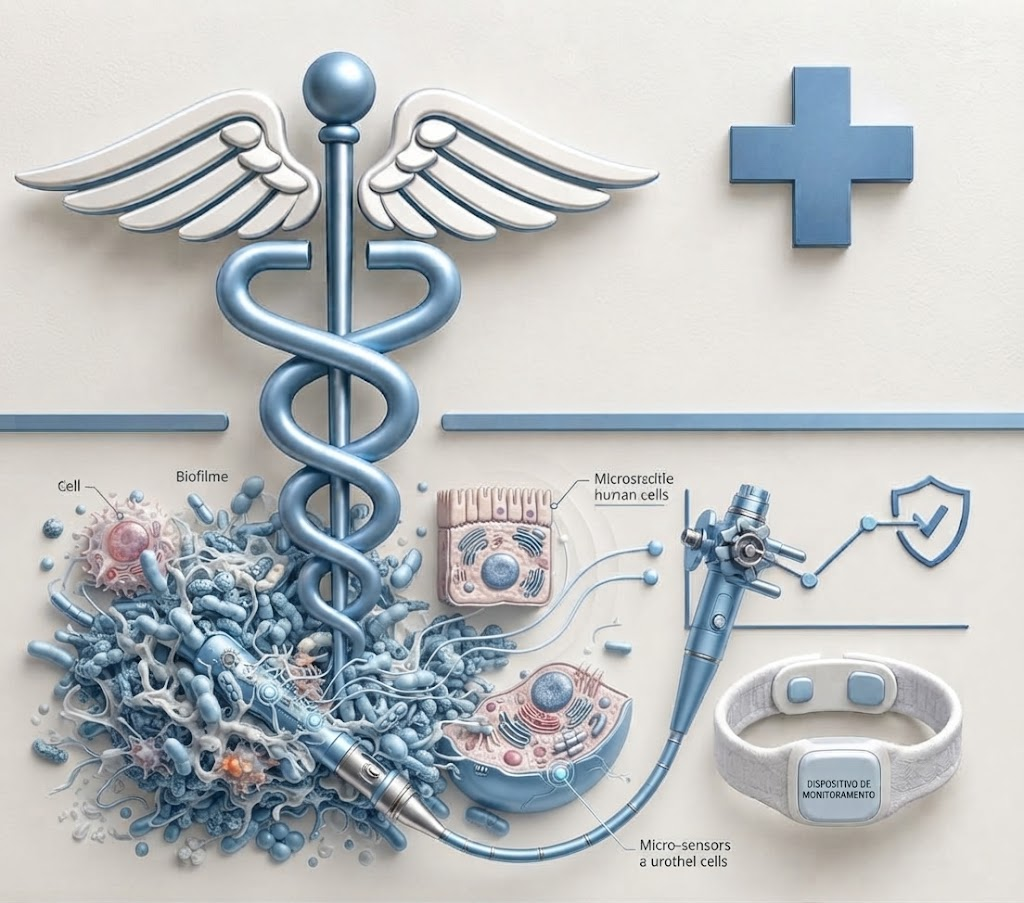
Introduction: Reusable flexible ureteroscopes have structural characteristics that make cleaning difficult and may favor the persistence of organic residues and biofilm formation, compromising microbiological safety. Objective: To discuss the challenges associated with biofilms on flexible ureteroscopes, reprocessing effectiveness, and infection prevention. Methods: A narrative literature review addressing biofilm formation, residual contamination, reprocessing failures, and strategies to prevent infections associated with endoscopic devices. Results: Evidence has identified residual contamination on ureteroscopes after processing and documented infection outbreaks associated with reusable devices. Factors related to reprocessing failures include inadequate cleaning, delays in processing, insufficient drying, structural damage, and traceability deficiencies. Audits, inspection, cleaning verification, and professional training may improve reprocessing quality. Conclusion: Infection prevention depends on rigorous implementation of all processing steps, assessment of device integrity, and continuous quality monitoring. Further studies are needed to clarify biofilm prevalence and its relationship with clinical risk.
References
1. Bashaw MA. Guideline implementation: processing flexible endoscopes. AORN J. 2016;104(3):225-236. doi:10.1016/j.aorn.2016.06.018.
2. Ofstead CL, Hopkins KM, Smart AG, Eiland JE. Reprocessing effectiveness for flexible ureteroscopes: critical look doi:10.1016/j.urology.2022.01.033. at the evidence. Urology. 2022;164:25-32.
3. Ofstead CL, Heymann OL, Quick MR, Johnson EA, Eiland JE, Wetzler HP. The effectiveness of sterilization for flexible ureteroscopes: a real-world study. Am J Infect Control. 2017;45(8):888-895. doi:10.1016/j.ajic.2017.03.016. cumulative
4. Legemate JD, Kamphuis GM, Freund JE, Baard J, Oussoren HW, Spijkerman IJB, et al. Pre-use ureteroscope contamination after high level disinfection: reprocessing effectiveness and the relation with ureteroscope doi:10.1097/JU.0000000000000108. use. J Urol. 2019;201(6):1144-1151.
5. Kumarage J, Khonyongwa K, Khan A, Desai N, Hoffman P, Taori SK. Transmission of multi-drug resistant Pseudomonas aeruginosa between two flexible ureteroscopes and an outbreak of urinary tract infection: the fragility of endoscope decontamination. J Hosp Infect. 2019;102(1):89-94. doi:10.1016/j.jhin.2019.02.015.
6. Centers for Disease Control and Prevention. Recommendations for disinfection and sterilization in healthcare facilities [Internet]. Atlanta: CDC; 2008 [atualizado em 2017; citado em 2026 Oct 10]. Disponível em: https://www.cdc.gov/infection-control/hcp/disinfection-sterilization/summary recommendations.html.
7. Takahashi S, Arakawa S, Ishikawa K, Kamei J, Kobayashi K, Shigemura K, et al. Guidelines for infection control in the urological field, including urinary tract management (revised second edition). Int J Urol. 2021;28(12):1198-1211. doi:10.1111/iju.14684.
8. Luo Y, Yang Q, Li B, Yao Y. Establishment of a quality control circle to reduce biofilm formation in flexible endoscopes by improvement of qualified cleaning rate. J Int Med Res. 2020;48(9):300060520952983. doi:10.1177/0300060520952983.
Downloads
Published
How to Cite
Issue
Section
License
Copyright (c) 2026 Ana Hecktheuer Canzi, Alice Pasquim Sugayama, Ana Hisi Fujii Ramos

This work is licensed under a Creative Commons Attribution 4.0 International License.
Os artigos publicados na International Journal of Health and Surgical Research são licenciados sob a Creative Commons Attribution 4.0 International (CC BY 4.0).
Isso permite que outros distribuam, remixem, adaptem e criem a partir do trabalho publicado, para qualquer finalidade, incluindo comercial, desde que seja dado o devido crédito ao autor original e à revista.
Os autores mantêm os direitos autorais de seus trabalhos e concedem à revista o direito de primeira publicação.